Flight Delay Compensation in 2026: What Every Passenger Needs to Know
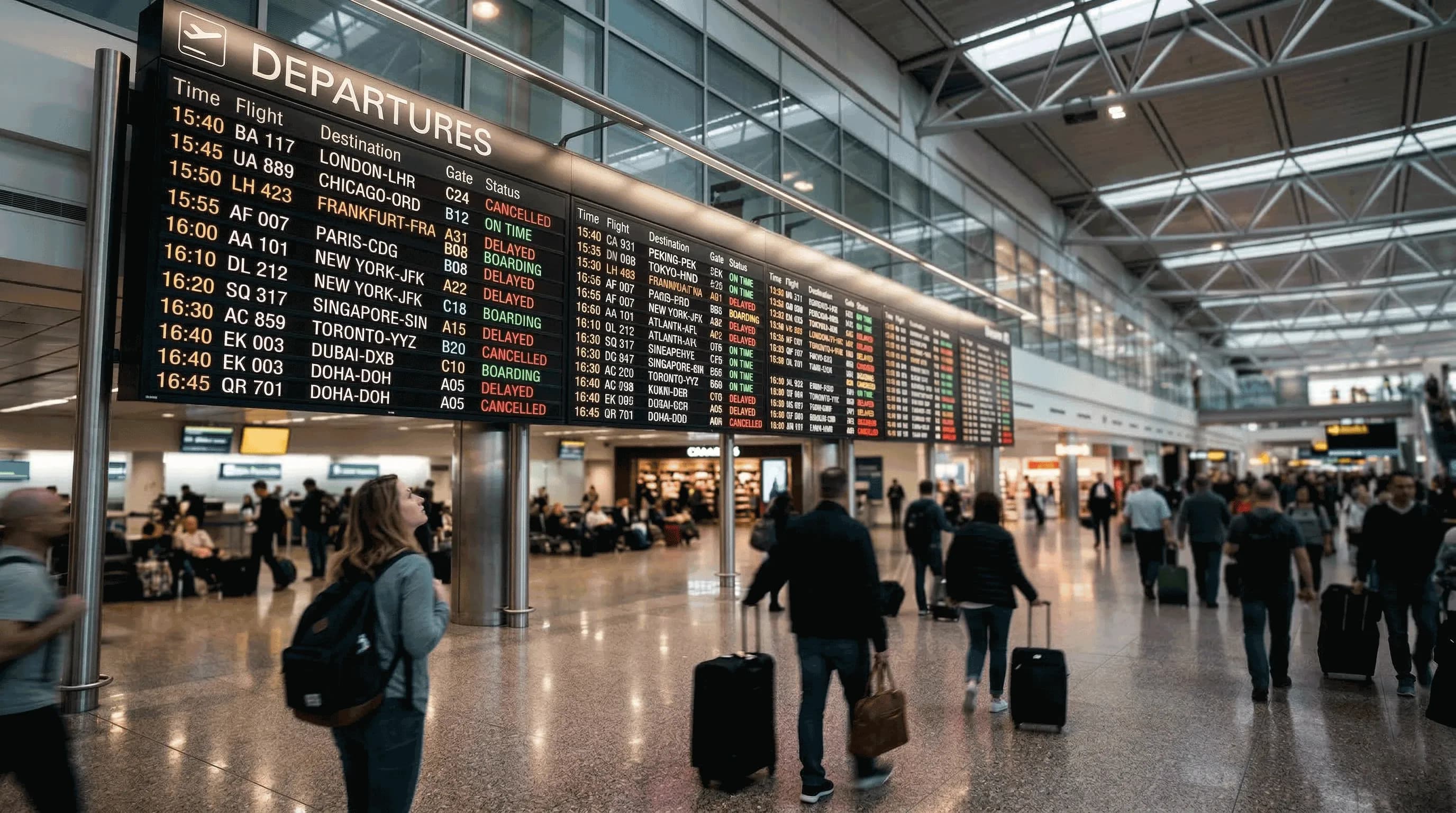
Flight delay compensation rules now cover more passengers in more countries than at any point in aviation history. Between the EU, UK, Canada, the United States, Brazil, Turkey, India, and Israel, there are distinct legal frameworks that protect travellers — each with its own eligibility criteria, compensation amounts, and enforcement mechanisms.
This guide maps the current landscape as of 2026, compares the major regimes side by side, and explains what you can practically do when your flight is delayed or cancelled.
EU261 in 2026
Regulation (EC) No 261/2004, commonly known as EU261, remains the global benchmark for passenger compensation. It applies to flights departing from any EU airport and to flights arriving in the EU when operated by an EU-based carrier.
The compensation amounts have not changed since 2004:
- €250 for flights up to 1,500 km
- €400 for flights between 1,500 km and 3,500 km
- €600 for flights over 3,500 km
What has changed is enforcement. National Enforcement Bodies (NEBs) across EU member states handled a record number of complaints in 2024–2025. Airlines that previously ignored claims or relied on blanket extraordinary circumstances defenses are seeing more pushback from regulators.
The key trend in 2026 is faster resolution. More passengers are filing through claims services, and more airlines are settling valid claims earlier to avoid regulatory scrutiny. For a detailed breakdown of qualifying flights, compensation amounts, and the extraordinary circumstances defense, see our EU261 guide.
UK261 after Brexit
The UK retained an almost identical version of EU261 through the Air Passenger Rights and Air Travel Organisers' Licensing (Amendment) (EU Exit) Regulations 2019, commonly called UK261. It covers:
- Flights departing from UK airports (any airline)
- Flights arriving in the UK from outside the UK when operated by a UK-based carrier
The compensation amounts mirror EU261 but are denominated in pounds sterling: £220, £350, and £520 depending on distance. The practical differences from EU261 are mostly procedural. UK passengers escalate to the Civil Aviation Authority (CAA) rather than an EU NEB, and enforcement data shows the CAA has become more active in pursuing airline compliance since 2024.
One important divergence: UK261 does not automatically apply to flights between EU countries, even if booked through a UK airline's website. The operating carrier and route determine jurisdiction.
Canada's APPR
Canada's Air Passenger Protection Regulations (APPR), enforced by the Canadian Transportation Agency (CTA), underwent significant changes in late 2024. The revised regulations simplified the distinction between situations within and outside the airline's control.
Current APPR compensation for large carriers:
- CAD $400 for delays of 3–6 hours
- CAD $700 for delays of 6–9 hours
- CAD $1,000 for delays of 9+ hours
For small carriers, the amounts are CAD $125, $250, and $500 respectively.
The CTA's annual compliance report noted a significant increase in complaint volumes following the 2024 amendments. Processing times remain a challenge, with the backlog still being worked through in 2026. If your flight involved a Canadian carrier or departed from a Canadian airport, the APPR is likely the applicable regime.
US DOT automatic refund rules
The biggest change in 2026 is in the United States. The US Department of Transportation's Final Rule on Automatic Refunds (DOT-OST-2022-0089) is now fully in effect. Unlike the EU and Canadian models, the US rule does not provide fixed compensation payments. Instead, it requires airlines to automatically issue refunds when:
- A flight is cancelled and the passenger does not accept rebooking
- A flight is significantly delayed (defined as 3+ hours for domestic flights, 6+ hours for international flights)
- The airline makes a significant change to the itinerary (time change, airport change, added connections)
The refund must be issued in the original form of payment within 7 business days for credit card purchases and 20 calendar days for other payment methods. Airlines can no longer substitute vouchers or travel credits without passenger consent.
This does not replace state-level protections or additional rights passengers may have under the Montreal Convention for international flights, but it does close a major gap that existed for US domestic travellers.
Brazil's ANAC Resolution 400
Brazil's civil aviation authority (ANAC) enforces Resolution 400, which provides passenger protections on flights departing from or arriving in Brazil. The compensation component applies specifically to denied boarding, with fixed amounts of USD $345 for domestic flights and USD $690 for international flights. The statute of limitations is 5 years for domestic and 2 years for international routes.
Beyond compensation, ANAC 400 also requires material assistance during delays — communication after 1 hour, food after 2 hours, and accommodation if overnight — plus rebooking or refund options for cancellations and extended delays.
Turkey's SHY Passenger Rights
Turkey's Directorate General of Civil Aviation (SHGM) enforces the SHY-Passenger regulation, which covers flights departing from Turkish airports and flights to Turkey operated by Turkish carriers. The delay threshold is lower than EU261 — compensation can apply from 2 hours for domestic flights (€100) and from 3–4 hours for international flights (€250–€600 depending on distance). The 1-year statute of limitations is shorter than most European countries, so acting quickly matters. Turkey's position as a major transit hub between Europe and Asia means these rules affect a large number of connecting passengers.
India's DGCA Passenger Charter
India's Directorate General of Civil Aviation (DGCA) sets passenger protection standards through its Civil Aviation Requirements. Compensation applies to both cancellations (INR 5,000–20,000 depending on delay) and denied boarding (INR 2,000–8,000). The 2-year statute of limitations and INR-denominated amounts make this a distinct regime, but the DGCA has been increasingly active in holding airlines accountable, particularly on domestic routes.
Israel's Aviation Services Law
Israel's Aviation Services Law (2012) provides passenger protections on flights departing from or arriving at Israeli airports. The delay threshold is 4 hours, higher than EU261's 3 hours. Compensation ranges from ILS 1,320 for shorter flights to ILS 3,180 for flights over 5,000 km. The generous 7-year statute of limitations gives passengers more time to file than most other regimes.
Compensation comparison across jurisdictions
| Regime | Region | Compensation range | Delay threshold | Time limit to claim |
|---|---|---|---|---|
| EU261 | EU/EEA | €250–€600 | 3 hours at arrival | Varies by country (2–6 years) |
| UK261 | United Kingdom | £220–£520 | 3 hours at arrival | 6 years (England/Wales) |
| APPR | Canada | CAD $125–$1,000 | 3 hours | 1 year (CTA complaint) |
| US DOT | United States | Full refund | 3 hours (domestic) / 6 hours (international) | Varies |
| ANAC 400 | Brazil | USD $345–$690 (denied boarding) | Denied boarding | 2–5 years |
| SHY | Turkey | €100–€600 | 2 hours (domestic) / 3 hours (international) | 1 year |
| DGCA | India | INR 2,000–20,000 | Varies by situation | 2 years |
| Aviation Services Law | Israel | ILS 1,320–3,180 | 4 hours | Up to 7 years |
The scale of unclaimed compensation
The numbers are striking. An estimated $26 billion in flight delay compensation goes unclaimed every single year. Roughly 30% of flights in European airspace alone experience some form of delay each year. Yet only about 2% of eligible passengers ever file a compensation claim.
The gap exists because passengers either do not know they have rights, assume the process is too difficult, or give up after an initial airline rejection. Many valid claims are turned down on a first attempt with vague references to extraordinary circumstances — a defense that is often misapplied.
How to maximize your claim
If you believe your flight qualifies for compensation under any of the regimes above, these steps will strengthen your position:
- Keep all documentation — boarding passes, booking confirmations, airline communications, and receipts for expenses incurred during the delay
- Note the actual arrival time — compensation under EU261 and UK261 is based on arrival delay, not departure delay
- Check the operating carrier — the airline that physically operated the flight determines which regime applies, not the airline you booked with
- Do not accept vouchers without understanding your rights — under the US DOT rules and EU261, you are entitled to cash compensation or refunds, not just travel credits
- Act promptly — limitation periods vary, but filing early gives you the strongest position
For a step-by-step walkthrough of the claims process, read our how to file a flight compensation claim guide. For practical tips on what to do at the airport when disruptions happen, see our flight delay tips.
If you want to skip the paperwork, airfairness can check your eligibility and handle the claim for you.
FAQ
Has EU261 compensation increased in 2026?
No. The fixed compensation amounts (€250, €400, €600) have not changed since the regulation was introduced in 2004. The European Commission has discussed revisions, but no legislative update has been enacted.
Do the US DOT refund rules apply to international flights?
Yes, but with different thresholds. For international flights, a "significant delay" is defined as 6 hours or more, compared to 3 hours for domestic flights. The rules apply to all airlines operating flights to, from, or within the United States.
Can I claim under multiple regimes for the same flight?
Generally no. Each flight is governed by one primary regime based on the departure point, arrival point, and operating carrier. However, you may have separate rights under the Montreal Convention for actual damages (hotel costs, missed events) in addition to fixed compensation under EU261 or similar rules.
How long do I have to file a compensation claim?
It depends on the jurisdiction. Under EU261, the time limit varies by member state — from 1 year in Belgium to 6 years in England and Wales. Under Canada's APPR, you must file a CTA complaint within 1 year. Under the US DOT rules, airlines must process refunds automatically, but you should follow up promptly if they do not.
For a broader overview of passenger rights across jurisdictions, visit our passenger rights page. Ready to check if your flight qualifies? Start a claim with airfairness.